
Real-time fraud detection,
built around your
business.
Detect fraud across digital banking, payments, accounts, merchants, lending and financial crime — with real-time intelligence and decisioning built for financial institutions.
Every transaction, inspected in-flight.
Payments enter from any rail, are scored against device, identity, behaviour, network and payment signals, and leave as an approve, a step-up challenge or a block — before the money moves.
BANKiQ Engine
Real-time risk decisioning
16 ms decisionDigital & Identity Fraud Detection
Protect every digital journey from login through payment with contextual, real-time risk decisions.
Protect internet and mobile banking journeys end-to-end, from login to logout, against session hijacking and transaction manipulation.
Modern banking is built on a continuous digital dialogue between the customer and the institution. BANKiQ monitors the entire session lifecycle — device binding, behavioural biometrics, navigation patterns, keystroke dynamics, copy-paste activity, browser instrumentation and network metadata — to detect when a legitimate session has been hijacked or manipulated by an attacker. The model scores not just the transaction, but the context in which it is initiated.
Detect credential compromise, session hijacking and device anomalies before a fraudster can move funds out of a hijacked account.
Account takeover is the gateway to most downstream fraud. BANKiQ layers credential intelligence with device and behavioural evidence to identify a hijacked account before any high-risk action is attempted. It correlates login anomalies, credential stuffing patterns, dark-web credential leakage, device reputation and behavioural drift into a single ATO risk score.
Flag credential stuffing, brute-force login attempts and suspicious login patterns before they escalate into account compromise.
Credential and login fraud is the earliest observable stage of most digital attacks. BANKiQ evaluates login velocity, IP reputation, device fingerprint entropy, password-spray patterns, time-of-day anomalies and keyboard/biometric drift to detect both automated and human-driven login attacks.
Detect recent SIM replacement, mobile-number changes and device-SIM mismatches that signal a SIM-swap fraud attempt.
SIM-swap attacks bypass SMS-based second-factor authentication and recovery flows. BANKiQ integrates telecom signals, last-SIM-change metadata, device-SIM binding, and mobile-number-porting alerts to detect when a phone number has been compromised before the attacker can receive an OTP or recovery code.
Identify rooted or jailbroken devices, emulators, malware indicators and remote-access tools before they're used to defraud an account.
A compromised device is the attacker's closest proxy to the customer. BANKiQ's device-risk engine inspects device integrity, operating system anomalies, emulator/virtual-machine signals, side-loaded applications, tamper indicators, and malware/traffic-tool fingerprints to isolate high-risk endpoints before a transaction is approved.
Identify phishing, fake customer-care scams, impersonation and KYC scams designed to manipulate customers into compromising their own accounts.
Social engineering attacks exploit trust, not technology. BANKiQ detects the behavioural aftermath of phishing and scams — unusual navigation, rushed data entry, coercion indicators, known phishing kit signals, and device changes that suggest a victim is being guided by a fraudster rather than acting independently.
Detect when a customer has been manipulated into authorizing a fraudulent payment — scoring victim behaviour, not just transaction authorization.
APP fraud relies on a legitimate customer authorizing a payment to a fraudster. BANKiQ's victim-behaviour model examines pre-transaction context — call indicators, screen-share activity, message urgency, payee novelty, behavioural hesitation, and channel switching — to detect coercion and manipulation at the moment of authorization.
Payments & Transaction Fraud Detection
Stop suspicious transactions across UPI, cards, transfers, wallets and other payment channels.
Real-time detection of fraudulent UPI transactions, mule-linked collect requests and social-engineering scams.
UPI moves funds in real time, so fraud detection must be faster than the payment itself. BANKiQ scores collect requests, payer-beneficiary relationships, device binding, VPA velocity, and transaction narration to identify mule-linked, scam-driven, or high-velocity UPI fraud in milliseconds.
Real-time controls for instant payment rails, where funds move irreversibly in seconds.
Instant payment rails are irreversible once executed, making detection timing critical. BANKiQ evaluates beneficiary risk, account-to-account velocity, transaction timing, device and network metadata, and historical counterparties to step up or block suspicious instant transfers before execution.
Flag suspicious new beneficiaries, rapid beneficiary addition and high-risk beneficiary networks before funds are transferred out.
Fraudsters often coerce victims into adding new beneficiaries or use accounts that have been recently added as payees. BANKiQ monitors beneficiary addition velocity, account-age patterns, mobile-number linkages, network centrality, and rapid post-addition transactions to detect risky payee behaviour.
Detect QR code replacement, malicious QR codes, merchant QR manipulation and collect-request abuse.
QR codes collapse payment intent into a single image, making them attractive to fraudsters. BANKiQ detects QR replacement, tampered merchant details, off-platform static QR abuse, and collect-request phishing by scanning transaction metadata, merchant reputation, and payer context at the point of scan.
Protect debit and credit card transactions across every acceptance channel in real time.
Card fraud spans physical and digital channels with different attack patterns. BANKiQ evaluates merchant category risk, transaction amount, location, device, 3DS behaviour, recurring-payment patterns, and cross-channel velocity to detect stolen-card use, card-not-present abuse, and counterfeit transactions.
Identify cash-withdrawal anomalies, card skimming, ATM compromise and cash-out behaviour.
ATMs remain a major cash-out channel for fraudsters. BANKiQ models withdrawal patterns, card-present device signatures, ATM terminal risk, time-of-day anomalies, and geographic clustering to detect skimming, card trapping, and rapid cash-out behaviour.
Detect point-of-sale fraud patterns at the moment of swipe, tap or dip.
POS terminals are a direct interface between stolen card data and merchant settlement. BANKiQ analyzes merchant risk, terminal behaviour, transaction amount, card-present vs. manual-entry indicators, and velocity patterns to detect counterfeit cards, fallback fraud, and collusive merchant activity.
Score online and CNP transactions for stolen-card use, friendly fraud and account-linked card abuse.
E-commerce and CNP transactions lack physical card verification, so risk is concentrated in digital signals. BANKiQ evaluates device identity, shipping-billing mismatch, account history, merchant risk, digital goods behaviour, and chargeback patterns to separate genuine shoppers from fraudulent actors.
Detect wallet top-up abuse, prepaid instrument (PPI) misuse and wallet-to-bank fraud patterns.
Prepaid wallets and PPIs can obscure the origin of funds and accelerate mule cash-outs. BANKiQ monitors wallet top-up velocity, load-to-cash-out ratios, wallet-to-wallet transfers, KYC tier limits, and linked bank accounts to identify abuse of closed-loop or semi-closed instruments.
Identify rapid transaction bursts, unusual frequency and velocity anomalies that signal an account is being drained.
Velocity is one of the strongest signals of an active compromise. BANKiQ builds customer-specific baselines for transaction count, amount, counterparties, and timing, then flags deviations that exceed adaptive thresholds — whether from a single burst or distributed low-value activity.
Monitor international remittances and cross-border payment flows for anomalies across corridors.
Cross-border transactions involve more complex routing, higher amounts, and less immediate recovery. BANKiQ scores corridors, correspondent Banks, beneficiary history, currency pairs, purpose codes, and sender-receiver patterns to detect trade-based money laundering, remittance scams, and fraud-driven outbound transfers.
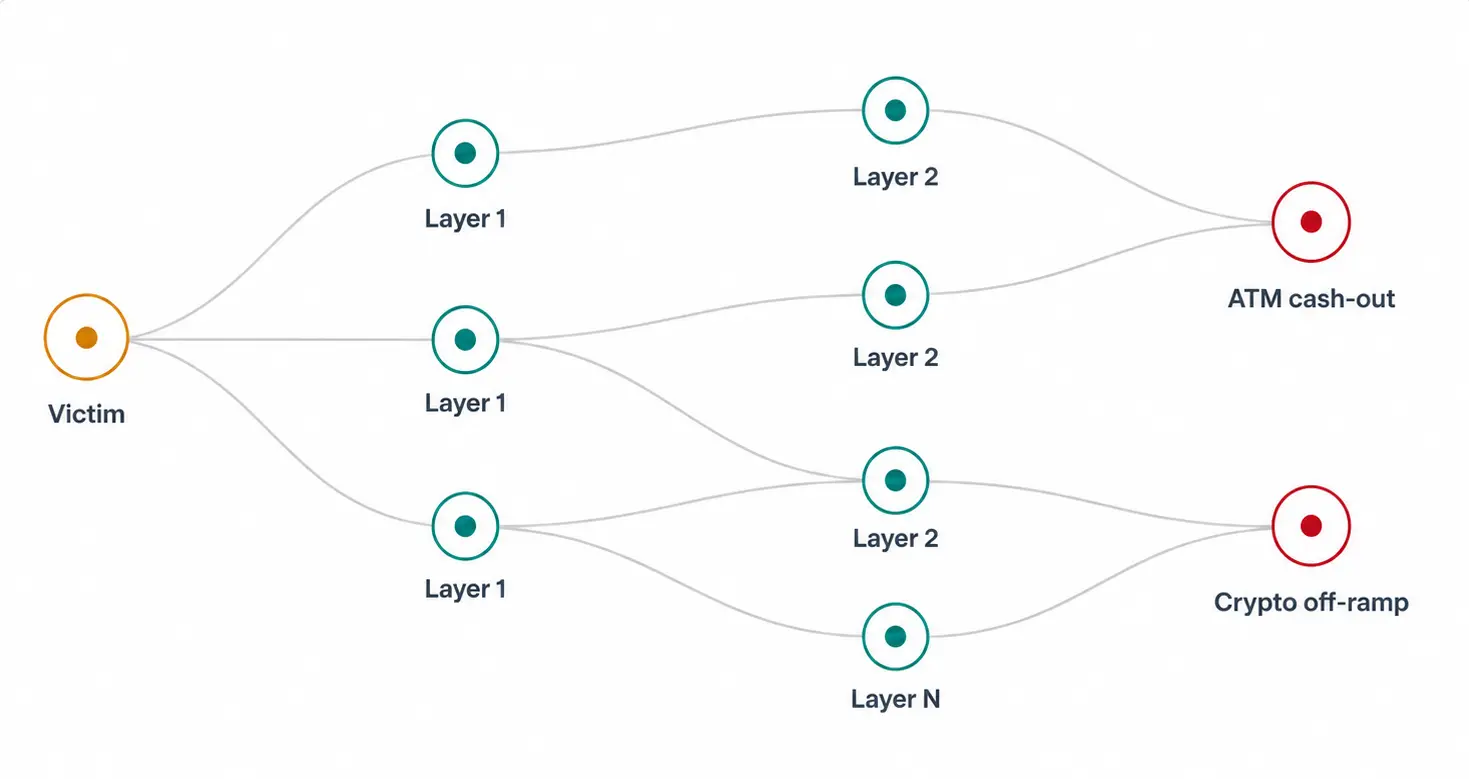
From victim to cash-out, the whole network.
Scroll to trace fraud proceeds as they fan out across Layer-1, Layer-2 and Layer-N mule accounts and converge on ATM and crypto off-ramps. BANKiQ maps customer, mobile, device, account, beneficiary, IP and merchant relationships to disrupt the chain before withdrawal.
- Layered mule tracing
- Rapid cash-out interception
- Mule re-entry detection
Mule Accounts & Financial Crime Detection
Identify mule behaviour, suspicious networks and abnormal movement of funds.
Identify individual accounts being used to receive and move stolen or laundered funds.
A mule account is the critical link between a fraud victim and a cash-out point. BANKiQ detects mule accounts by combining transaction topology, account-opening behaviour, device and mobile linkages, KYC quality, and rapid pass-through patterns that indicate an account is being used as a conduit rather than for genuine banking.
Identify the entire mule network behind a fraud — not just one account — from victim to cash-out.
Mule accounts are rarely isolated. BANKiQ uses graph analytics to discover clusters of accounts connected by common devices, mobile numbers, beneficiaries, IPs, KYC agents, and transaction patterns. Network-level detection exposes the full cash-out chain and enables preventive action before the network scales.
Trace fraud proceeds across multiple layers of mule accounts as funds are moved to obscure their origin.
Sophisticated operations split funds across multiple layers to hide the trail. BANKiQ traces the propagation path from initial receipt through intermediate distribution accounts to final cash-out, identifying layered structures that evade single-account detection.
Catch fraud-to-mule-to-cash-out chains before funds are withdrawn or moved beyond recovery.
The cash-out window is the last opportunity to recover stolen funds. BANKiQ monitors for rapid movement from deposit to ATM withdrawal, UPI collect, wallet transfer, or foreign exchange, and triggers alerts or blocks when the velocity indicates an active cash-out.
Flag customers with a history of mule-linked activity who re-enter the banking ecosystem via a new account, mobile number or device.
Closed mule accounts often reappear under slightly different identities. BANKiQ maintains persistent risk markers for devices, mobile numbers, addresses, and biometric fragments to flag re-entry attempts even when the account name and KYC documents are new.
Map relationships across customer, mobile, device, account, beneficiary, IP and merchant to expose hidden fraud networks.
Fraud networks hide in plain sight across disconnected data silos. BANKiQ links entities across channels to build a unified network view, revealing dense clusters, unusual bridges, and high-risk intermediaries that would be invisible with account-level checks alone.
Merchant & Acquirer Risk Management
Protect onboarding, payments and settlement across the merchant lifecycle.
Screen new merchants for fraud risk before they're approved to accept payments.
A fraudulent merchant is a payment gateway into the legitimate financial system. BANKiQ evaluates merchant identity, business legitimacy, ownership structure, website and app metadata, settlement patterns, and network associations during onboarding to prevent high-risk merchants from being boarded.
Continuously score merchant behaviour for signs of fraud, collusion or non-compliance.
Merchant risk evolves after onboarding. BANKiQ continuously scores transaction patterns, refund velocity, chargeback rates, customer disputes, and channel mix to identify merchants that are deteriorating or intentionally gaming the system.
Detect coordinated fraud between merchants and customers, or across merchant networks.
Collusion involves merchants and customers working together to create fake transactions or inflate refunds. BANKiQ detects circular payment flows, synthetic purchases, refund fraud, and coordinated chargeback behaviour by linking merchants, customers, devices, and accounts.
Identify undisclosed or unauthorized products and services being processed through a merchant's payment channel.
Transaction laundering hides high-risk transactions behind a legitimate merchant's credentials. BANKiQ compares transaction descriptors, MCC codes, customer complaints, and online presence with the merchant's declared business to identify laundered or undisclosed sales.
Detect unauthorized access to and manipulation of a legitimate merchant's account.
A compromised merchant account can be used to redirect settlements, alter descriptors, or process fraudulent transactions. BANKiQ monitors login behaviour, credential changes, settlement-account modifications, and API-key anomalies for merchant accounts.
Flag anomalies in merchant settlement patterns that indicate fraud or manipulation.
Settlement is where merchant fraud turns into realized cash. BANKiQ watches for settlement timing changes, account routing changes, unusually rapid withdrawals, and mismatches between transaction volume and settlement value.
Detect suspicious merchant portfolios, rapid merchant settlement and merchant-to-merchant fund flows across aggregator platforms.
Aggregators and payment service providers host large portfolios of merchants, creating systemic risk. BANKiQ monitors sub-merchant risk propagation, cross-merchant fund flows, settlement velocity, and concentration risk across the aggregator platform.
EWS - Lending & Enterprise Fraud Detection
Catch loan and enterprise fraud earlier with contextual signals and real-time risk assessment.
Flag suspicious activity immediately before or after loan disbursement.
Fraud around disbursement can involve redirecting funds, ghost borrowers, or kickback schemes. BANKiQ monitors disbursement account changes, beneficiary risk, sudden account dormancy breaks, and velocity immediately following disbursement.
Monitor for fraud across origination, disbursement, repayment, restructuring and closure.
Fraud can enter at any stage of a loan's life. BANKiQ provides continuous monitoring from origination through closure, detecting anomalies in repayment patterns, restructuring requests, foreclosure behaviour, and write-off attempts.
Distinguish genuine financial stress from deliberate fraudulent borrower behaviour.
First-party fraud involves borrowers who intentionally misrepresent their situation. BANKiQ differentiates willful default from genuine hardship using behavioural patterns, asset movement, income consistency, and repayment intent signals.
Extend real-time risk controls to in-branch and assisted-channel transactions.
Branch channels can be exploited by both insiders and external fraudsters. BANKiQ brings real-time risk scoring to assisted channels, including branch transactions, teller activity, and relationship-manager-initiated changes.
Detect employee-enabled fraud and policy circumvention across banking operations.
Insiders have privileged access and knowledge that can bypass controls. BANKiQ monitors employee access patterns, transaction approvals, data exports, and maker-checker overrides to detect internal misuse and collusion.
Detect collusion that circumvents maker-checker and segregation-of-duties controls.
Segregation of duties exists specifically to prevent single points of abuse. BANKiQ detects when two or more employees collude to approve suspicious transactions, alter customer data, or override risk flags in coordinated ways.
Flag misuse of privileged system access by employees and administrators.
Privileged users can disable controls, view sensitive data, and approve exceptions. BANKiQ monitors administrator actions, access to sensitive systems, bulk data operations, and configuration changes to detect abuse of high-privilege accounts.
Flag suspicious reactivation and movement on accounts that suddenly wake up after a long period of inactivity.
Dormant accounts are attractive to fraudsters because they bypass typical monitoring baselines. BANKiQ detects sudden reactivation, balance liquidation, beneficiary changes, and channel changes on long-inactive accounts.
Intelligence for enterprise fraud prevention.
BANKiQ doesn't just detect individual fraudulent transactions — it's built to connect with the national and regional fraud-intelligence ecosystem your institution operates within.
India — National Fraud Intelligence Ecosystem
Aligned with RBI's fraud risk management expectations and India's national cyber-fraud and telecom-intelligence infrastructure.
Fraud Risk Management Directions, Early Warning Signals (EWS) and Red Flagged Account (RFA) frameworks.
Reserve Bank Innovation Hub platforms for AI-driven mule detection and cross-institution fraud-intelligence sharing.
Indian Cyber Crime Coordination Centre infrastructure for cyber-fraud reporting, response and suspect-account intelligence.
Department of Telecommunications' Digital Intelligence Platform for mobile-number and telecom-linked fraud risk.
Payment-ecosystem risk signals and fraud intelligence across UPI and other national payment rails.
GCC — Regional Regulatory Readiness
Mapped to the counter-fraud frameworks of central Banks across the UAE, Saudi Arabia, Bahrain, Kuwait, Qatar and Oman.
Real-time fraud monitoring, fraud incident reporting and cross-institution fraud information sharing.
Counter-Fraud Framework alignment across governance, prevention, detection, response and technology.
Real-time fraud assessment and early-warning signal monitoring across digital payment channels.
Alignment with the Fraud Shield initiative and centralized dispute-management workflows.
Online authorization decisioning, velocity checks and fraud monitoring across branch, internet, ATM and phone banking.
Enterprise-wide fraud risk management and prevention framework alignment.
Southeast Asia — Regional Regulatory Readiness
Mapped to national scam-response and fraud-intelligence infrastructure across Singapore, Malaysia, Thailand, Indonesia and the Philippines.
Shared Responsibility Framework alignment and real-time fraud surveillance for phishing-related unauthorized transactions.
National Scam Response Centre and National Fraud Portal ecosystem alignment for rapid fraud response.
Central Fraud Registry alignment with individual and corporate mule-account intelligence sharing.
Indonesia Anti-Scam Centre-aligned account-risk, blocking and fund-recovery workflows.
AFASA-aligned automated, real-time fraud monitoring and blocking of disputed or suspicious transactions.
Don't see your exact fraud scenario?
Fraud typologies evolve constantly. If you're facing something new, talk to a fraud risk expert directly.